In the realm of high-frequency electronics, RF PCB design and manufacturing represent a specialized discipline where minute decisions during design and fabrication directly impact real-world system reliability and performance. Unlike standard PCBs used for low-speed digital systems, RF PCBs must preserve signal integrity, control parasitic effects, and maintain stable electrical properties throughout manufacturing variations. This article SprintPCB focuses on practical engineering and production considerations for RF PCB—from initial prototyping decisions to volume manufacturing best practices.

Designing an RF PCB board for real-world use requires a mindset that goes beyond simulation accuracy. Engineers must consider manufacturing tolerances, process variations, and long-term stability from the earliest design stage.
In practical engineering, an RF PCB layout must faithfully represent the electrical design while remaining manufacturable at scale. Transmission line geometry, reference plane continuity, and signal routing consistency all need to be preserved during fabrication. Designs that push extreme geometries or rely on idealized assumptions often experience performance variation once they enter production, especially when dielectric thickness or copper profiles fluctuate within allowable tolerances.
RF PCB layouts optimized for yield tend to favor consistency over theoretical extremes. By maintaining uniform trace geometry, predictable via structures, and balanced copper distribution, engineers reduce stress during lamination and etching. These design decisions help ensure that RF performance remains stable across different panels, batches, and production cycles, which is essential for volume manufacturing.
Manufacturing standards define how accurately an RF PCB reflects its original design intent. Tight process control is essential because even minor deviations can affect high-frequency behavior.
Professional RF PCB manufacturing requires strict control over lamination parameters, dielectric thickness, copper etching accuracy, and plating uniformity. Variations at any stage can introduce impedance drift or signal attenuation. Stable fabrication processes ensure that every RF PCB produced behaves similarly, allowing engineers to rely on predictable electrical performance rather than compensating for board-to-board differences.
Successful RF PCB projects align design specifications with proven manufacturing capabilities. When trace width, spacing, layer count, and board thickness fall within well-established process windows, manufacturers can maintain tighter control and higher yields. This alignment minimizes production risk and helps avoid late-stage design changes that can disrupt schedules and budgets.
A well-defined stackup is critical in RF PCB design, but consistent execution during manufacturing is what ultimately determines performance.
Accurate layer registration and consistent dielectric thickness are essential to preserving RF signal behavior. Misalignment or thickness variation can alter impedance characteristics and introduce phase mismatch across RF paths. Manufacturers with advanced process monitoring ensure that each layer is positioned and bonded precisely, maintaining the electrical relationships defined in the original stackup design.
In multilayer RF PCBs, continuous and uniform ground planes are vital for predictable return current paths. Manufacturing processes must preserve plane integrity by avoiding voids, excessive copper thinning, or discontinuities. A stable ground structure directly contributes to reduced noise, lower radiation, and consistent RF performance across the board.
Quality control in RF PCB production is a continuous process that spans material handling, fabrication, and final inspection.
Consistent RF PCB performance begins with controlled raw materials. Manufacturers verify laminate batches, copper foil specifications, and prepreg properties before production begins. By maintaining material traceability and consistency, variability in dielectric behavior and mechanical stability can be minimized.
Throughout fabrication, RF PCBs are inspected using automated optical inspection, X-ray analysis, and microsection evaluation. These inspections detect deviations in trace geometry, via integrity, and layer structure early in the process, preventing defective boards from advancing to assembly or final testing.
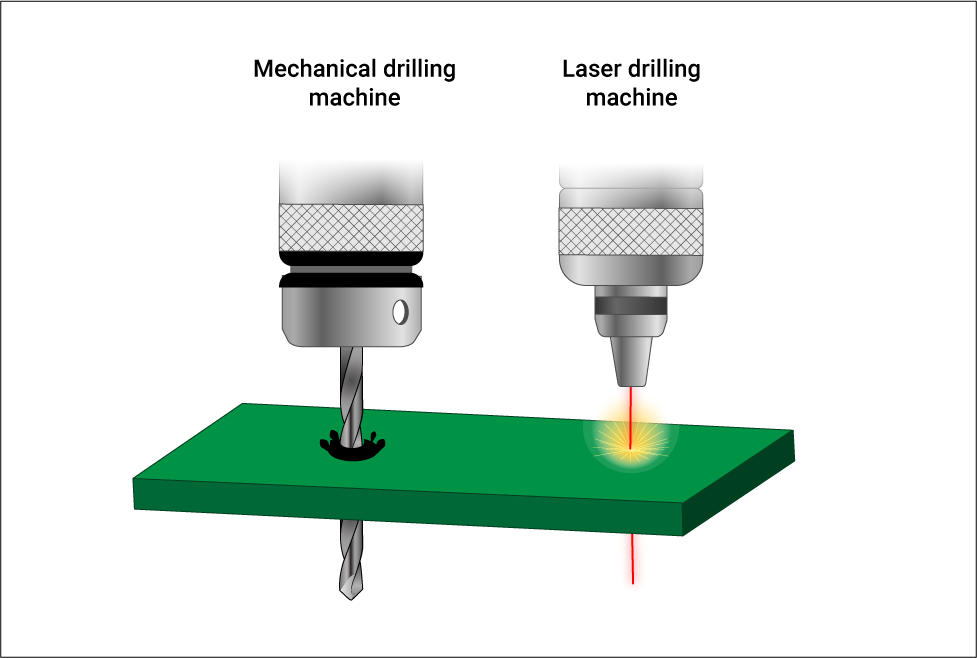
When selecting a manufacturing partner for RF PCB production, advanced process control, material expertise, and consistent quality are critical to achieving reliable high-frequency performance. SprintPCB RF PCB manufacturing capabilities are designed to support both performance and production yield, offering a broad range of technical specifications including 4–20 layer constructions, low-loss and low dielectric constant materials such as high-performance FR-4, PPO, PTFE, and hydrocarbon/ceramic-filled laminates, finished copper weights from 0.5 to 6 oz, board thicknesses ranging from 0.40 mm to 6.0 mm, maximum panel sizes up to 620 mm × 720 mm, fine-line capability down to 0.075 mm trace and space, minimum mechanical drill sizes of 0.15 mm, and multiple surface finish options including HASL, LF HASL, OSP, ENIG, immersion tin or silver, electroplated gold, and gold fingers. Together, these capabilities enable SprintPCB to support a wide range of RF PCB applications, from precision analog circuits to high-density radio frequency modules, with consistent quality and dependable manufacturing performance.
An RF PCB is only as good as its performance in real-world conditions. Successful RF PCB projects rely on practical design execution, disciplined manufacturing standards, rigorous testing, and continuous quality control. By focusing on manufacturability and validation—not just theory—engineering teams can deliver RF PCB solutions that perform consistently, scale reliably, and meet demanding application requirements.
For OEMs and system designers, working with an experienced RF PCB manufacturer that understands real engineering constraints is essential to transforming design intent into dependable products.

Customer support


 Building A19 & C2, Fuqiao No. 3 District, Fuhai Street, Bao'an District, Shenzhen, China
  +86-0755 2301 4280


 Language